
The concept of search engine optimization (SEO) has seen substantial changes with the emergence of artificial intelligence (AI). These days, to be ranked high in search engines such as Google is no longer about stuffing key words, or having backlinks. Rather, AI-enhanced SEO concentrates on the intent of users, content quality, technical performance, and constant optimism. Companies who learn the ways that AI can impact search engines will be able to create a more robust and sustainable presence on the internet.Technical SEO
The following are the basics of SEO utilizing AI that any marketer, content developer, or business owner must know.
Understanding Search Intent in AI-Driven SEO
A better comprehension of search intent is one of the most significant changes AI has made to SEO. Now machine learning models are used by search engines to understand what users mean by typing a query, and not simply finding the exact keywords.
Search intent generally can be divided into four categories, such as informational, navigational, transactional, and commercial investigation. AI assists search engines to examine the context, behavior patterns, and semantic meaning of information, so as to identify which kind of content is best suited to respond to a query.
To provide an example, when a user types in the query for best laptops for students, and the AI understands the query is likely to be about comparisons, reviews, and recommendations, and not just a list of the best laptops. It implies that the content must be designed in a manner that it directly responds to the needs of the user and not just pass the keywords through the material.
In order to be search-intent-optimal, content creators must:
- Concentrate on actually responding to the actual user questions in a clear and comprehensive manner.
- Evaluate similar search queries and People also ask.
- Adopt natural language which reflects the manner in which users speak and search.
The key to AI-powered SEO is that understanding intent determines how the content can be useful and relevant to the search engine in its attempt to provide relevance and satisfaction.
High-Quality Content and Topical Authority
Quality of content is now more crucial than ever before provided by AI. Search engines have come to assess whether content exhibits knowledge, depth and credibility. This can be commonly described as E-E-A-T: Experience, Expertise, Authoritativeness, and Trustworthiness.
Websites must develop topical authority rather than produce small, surface level articles. This involves addressing a topic in a holistic manner in a number of connected but independent pieces of information.
An example of this is that a digital marketing blog should not just write about SEO but also discuss in depth the concepts of keyword research, link building, content strategy, and analytics. AI systems are aware of this set of similar content and reward sites that display authority within a particular niche.
The major guidelines to develop quality content are:
- Composing full-bodied, well-researched articles.
- Using supporting data, examples, and case studies
- Organizing material in a logical manner to make it readable.
- Periodically revising old information in order to keep it up to date.
Artificial intelligence can also assist in detecting the areas of content, proposing improvements, and providing uniformity across topics. Nevertheless, the human mind is still very important when it comes to developing content that is meaningful and entertaining.
Keyword Strategy Enhanced by AI Tools
Keywords research is a fundamental aspect of SEO analysis, yet AI has disrupted the process of it. Rather than concentrating solely on individual keywords, contemporary SEO focuses on semantic keywords, and related words and topic clusters.
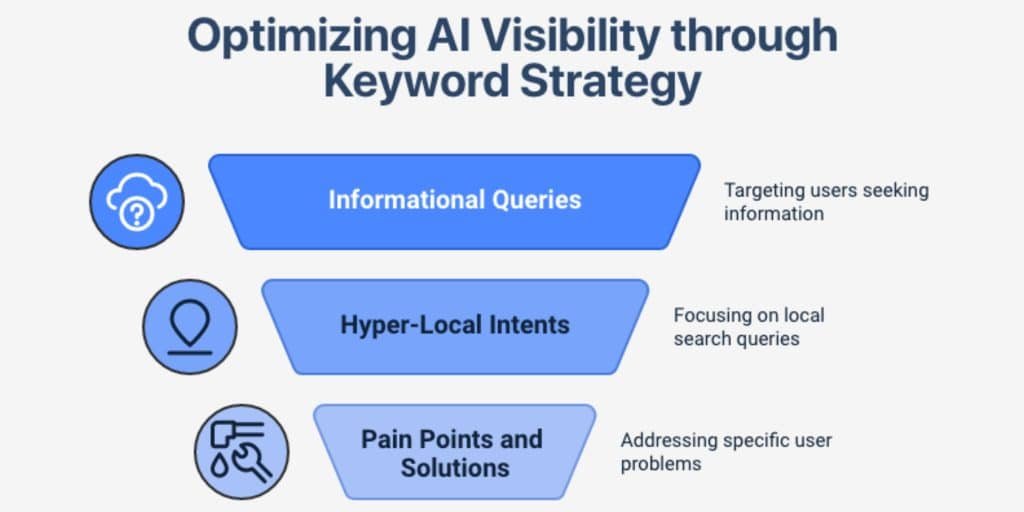
Artificial intelligence (AI) can be used to process large amounts of data and determine:
- Long-tail keyword opportunities.
- Search trend and seasonal trend.
- Connected questions and talk queries.
- Competitor keyword strategies.
This enables marketers to develop content that spans a wider array of search terms intuitively, enhancing the visibility across diverse search queries.
However, it is no longer the purpose to stuff keywords into the material. Rather, AI assists in incorporating keywords in a manner that is natural and contextual. Keywords optimization has become more complex as search engines now comprehend synonyms, variations and context.
An AI-powered keyword strategy is strong and targets:
- Relevance of topic as compared to exact-match keywords.
- Natural language integration.
- User-focused phrasing rather than robotic repetition
It is a better strategy to enhance the rankings as well as the user experience.
Technical SEO and Site Performance
The most quality content will find it difficult to rank when a site is experiencing technical problems. AI-based search engines give much attention to the technical aspects of SEO when ranking the pages.
The most important technical factors are the speed of the site, mobile responsiveness, crawlability, indexing, and structured data. The AI systems examine the degree to which search engines can access and comprehend the content on websites.
For example, a slow-loading web site raises the bounce rates, which is indicative of poor user experience. In the same manner, a non-mobile friendly site might not rank highly since most searches are currently done on a mobile phone.
Some of the key technical SEO activities are:
- Maximizing the page load speed.
- Ensuring mobile-first design.
- Using clean and structured URLs.
- Adopting schema markup of rich results.
- Repairing links and crawl errors.
Technical audits can also be automated with the help of AI tools that can quickly detect the issues that might influence rankings. This will streamline and make site maintenance more accurate and effective.
User Experience and Engagement Signals
AI does not simply analyze the content, but instead it studies the interaction of the users with the content. The engagement indicators like click-through rates, time on page, bounces, and scroll depth all affect the performance of SEO.
In case of fast exits of a page, search engines can consider it as irrelevant or of low quality. Conversely, the high engagement indicators imply that the content is practical and fulfilling.
An excellent user experience (UX), in turn, is the key to AI-based SEO success.
This includes:
- Easy and understandable site navigation.
- Clear formatting using short paragraphs and headings.
- Quick page loading and responsiveness.
- Interacting graphics and multimedia.
The content must be accessible to consume using all the devices. The AI systems have begun to value pages that retain the users interested and have an impactful interaction.
Enhancing UX, not only improves SEO ranking, but also conversions and customer satisfaction.